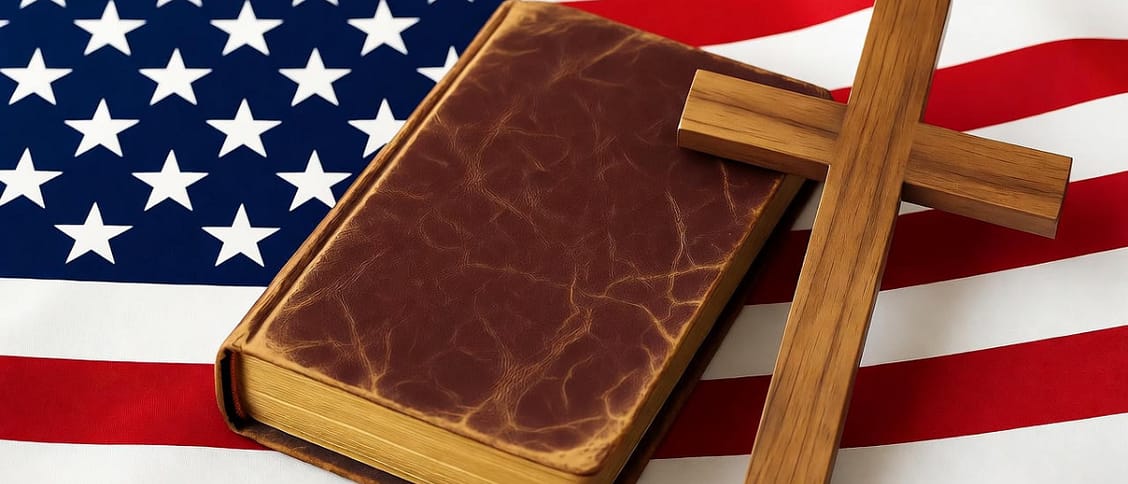

When examining the foundational documents, cultural traditions, and institutional frameworks that shaped the United States, a compelling argument emerges that America was established with deeply Christian underpinnings.
While the nation has always embraced religious pluralism and protected individual conscience, the wholesale retreat from these Christian moorings in recent decades correlates with observable social fragmentation.
This relationship deserves serious consideration as communities across America grapple with unprecedented levels of isolation, distrust, and civic dysfunction.
The Historical Record
The evidence of Christianity’s formative influence on American society is substantial and multifaceted.
The Mayflower Compact of 1620 explicitly invoked the voyage as being undertaken “for the Glory of God, and Advancement of the Christian Faith.” Colonial charters routinely referenced divine providence and Christian purpose.
When the Continental Congress convened, it opened with prayer. The Declaration of Independence itself appeals to “Nature’s God,” the “Creator,” “Supreme Judge of the world,” and “divine Providence”—language steeped in the theistic worldview that dominated the founding era.
Beyond official documents, the broader culture was saturated with Christian assumptions. Education at institutions like Harvard, Yale, and Princeton began with explicitly Christian missions to train clergy and instill biblical literacy.
The Northwest Ordinance of 1787 stated that “religion, morality, and knowledge, being necessary to good government and the happiness of mankind, schools and the means of education shall forever be encouraged.”
The reference to religion and morality was understood within a Christian framework that provided the ethical vocabulary of the age.
Even figures often cited as deists or skeptics operated within a Christian cultural context. George Washington frequently invoked Providence and insisted that “religion and morality are indispensable supports” for political prosperity.
John Adams wrote that “our Constitution was made only for a moral and religious people. It is wholly inadequate to the government of any other.”
Whether these men held orthodox theological views is less significant than recognizing they believed republican government required the moral formation that Christianity provided.
The Social Capital of Shared Belief
For generations, churches and synagogues served as the primary institutions of community life across America.
They provided not merely worship services but social networks, mutual aid, educational opportunities, and moral instruction.
Tocqueville observed in the 1830s that America’s religious vitality was essential to its democratic success, creating the “habits of the heart” necessary for self-governance.
Religious congregations taught virtues like self-restraint, delayed gratification, honesty, and concern for neighbors—precisely the characteristics required for a free society to function without heavy-handed state control.
This religious ecosystem created what sociologists call “social capital”—the networks of trust and reciprocity that enable communities to solve collective problems.
When families attended the same church for generations, when business dealings were conducted among fellow congregants, when civic leaders were drawn from church boards, there existed powerful informal mechanisms for maintaining social order and mutual obligation.
Reputation mattered because it was tracked within stable, morally grounded communities.
The shared moral vocabulary derived from Christianity allowed diverse Americans to communicate about values despite other differences.
When political leaders invoked biblical principles or religious values, they could assume a common reference point. This didn’t require theological uniformity, but it provided a shared framework for ethical reasoning.
Citizens could debate policy while agreeing on fundamental premises about human dignity, moral responsibility, and the existence of transcendent truth.
The Secularization Thesis
Beginning in the mid-twentieth century and accelerating dramatically in recent decades, America has experienced rapid secularization.
Church attendance has plummeted, particularly among younger generations. The percentage of Americans claiming no religious affiliation has skyrocketed from single digits to nearly thirty percent.
Religious literacy has collapsed—surveys show most Americans cannot name the four Gospels or explain basic theological concepts that once formed the foundation of cultural knowledge.
This shift represents more than mere disaffiliation from organized religion. It reflects the disappearance of a shared moral framework. When transcendent authority is removed, ethics become matters of personal preference or social construction.
The question “What is good?” transforms from an inquiry into objective truth to an expression of individual feeling.
Without agreed-upon standards rooted in something beyond human opinion, moral discourse devolves into assertion and counter-assertion, power struggles rather than reasoning toward truth.
The institutions that once transmitted Christian values have either secularized or lost cultural influence. Public schools that once included prayer and Bible reading now scrupulously avoid religious expression.
Universities that began as explicitly Christian institutions now often regard religious belief with suspicion or hostility. Media and entertainment that once reinforced traditional moral norms now frequently mock them.
The result is a society where successive generations are raised without the moral vocabulary and communal structures that previously sustained social cohesion.
Observable Consequences
The correlation between secularization and social breakdown manifests across multiple domains. Family stability has deteriorated dramatically.
Divorce rates exploded as traditional religious constraints weakened, though they’ve recently declined primarily because fewer people marry at all.
Out-of-wedlock births have increased from roughly five percent in 1960 to over forty percent today.
Cohabitation has replaced marriage for many, producing less stable environments for child-rearing. These patterns track closely with declining religious observance.
Social isolation has reached epidemic proportions. Despite unprecedented technological connectivity, reported loneliness has surged.
Civic participation has collapsed—people join fewer clubs, know fewer neighbors, and engage less in community life.
Robert Putnam documented this trend in “Bowling Alone,” noting that religious congregations were historically the largest source of social capital in America.
As church attendance declined, nothing adequately replaced these community structures.
Mental health crises have intensified, particularly among young people. Anxiety, depression, and suicide rates have climbed even as material prosperity has increased.
While correlation doesn’t prove causation, research consistently shows religious participation associates with better mental health outcomes, greater life satisfaction, and stronger social support networks.
The loss of transcendent meaning leaves many adrift in a universe they perceive as purposeless, contributing to what some call “deaths of despair.”
Trust has eroded at every level.
Americans increasingly distrust institutions, neighbors, and fellow citizens. Political polarization has reached historic levels, with partisans viewing opponents not merely as wrong but as morally defective.
Without shared moral foundations, political disagreements become existential battles rather than good-faith debates.
The common ground that religious values once provided has fractured into competing worldviews with no agreed-upon method for adjudicating between them.
The Moral Formation Vacuum
Perhaps most concerning is the question of where moral formation now occurs.
When religious institutions performed this function, they did so within traditions refined over centuries, rooted in texts and teachings that made claims about human nature and ultimate reality.
They cultivated virtues through regular practice, community accountability, and connection to something beyond the self.
What has replaced this? For many, morality becomes whatever feels right individually or whatever gains social media approval. Ethical reasoning gives way to emotional reaction.
The cultivation of virtue—patience, humility, forgiveness, self-sacrifice—receives little systematic attention. Instead, therapeutic language emphasizes self-esteem, authenticity, and personal fulfillment without corresponding emphasis on duty, restraint, or transcendent purpose.
This creates what some philosophers call “moralistic therapeutic deism”—a vague belief in being nice and feeling good about oneself, divorced from robust moral reasoning or demanding ethical obligations.
Such thin moral gruel cannot sustain the habits required for stable families, functional communities, and healthy democratic discourse.
It produces what sociologist Christian Smith calls “emerging adults” who lack the moral vocabulary to articulate beliefs beyond personal preference.
The Path Forward
Recognizing America’s Christian heritage and the social consequences of its erosion doesn’t require imposing religious belief through government power.
The First Amendment’s religious protections remain essential. However, it does suggest that societies require shared moral frameworks rooted in something beyond individual preference, and that the complete privatization of religion creates a vacuum with destructive consequences.
Communities might benefit from recovering an appreciation for the social functions religious institutions performed—moral formation, community building, meaning-making—even as pluralism continues.
This could involve renewed respect for religious institutions in public discourse, recognition that faith communities provide irreplaceable social infrastructure, and acknowledgment that purely secular approaches to ethics face serious philosophical and practical limitations.
The breakdown of social cohesion America currently experiences has many causes, but the rapid secularization of a society built on Christian foundations is a significant factor.
The institutions, values, and assumptions that once bound diverse Americans together have weakened without adequate replacement.
Addressing our current crisis may require honest conversation about the role religious belief played in sustaining the social fabric we now struggle to repair.